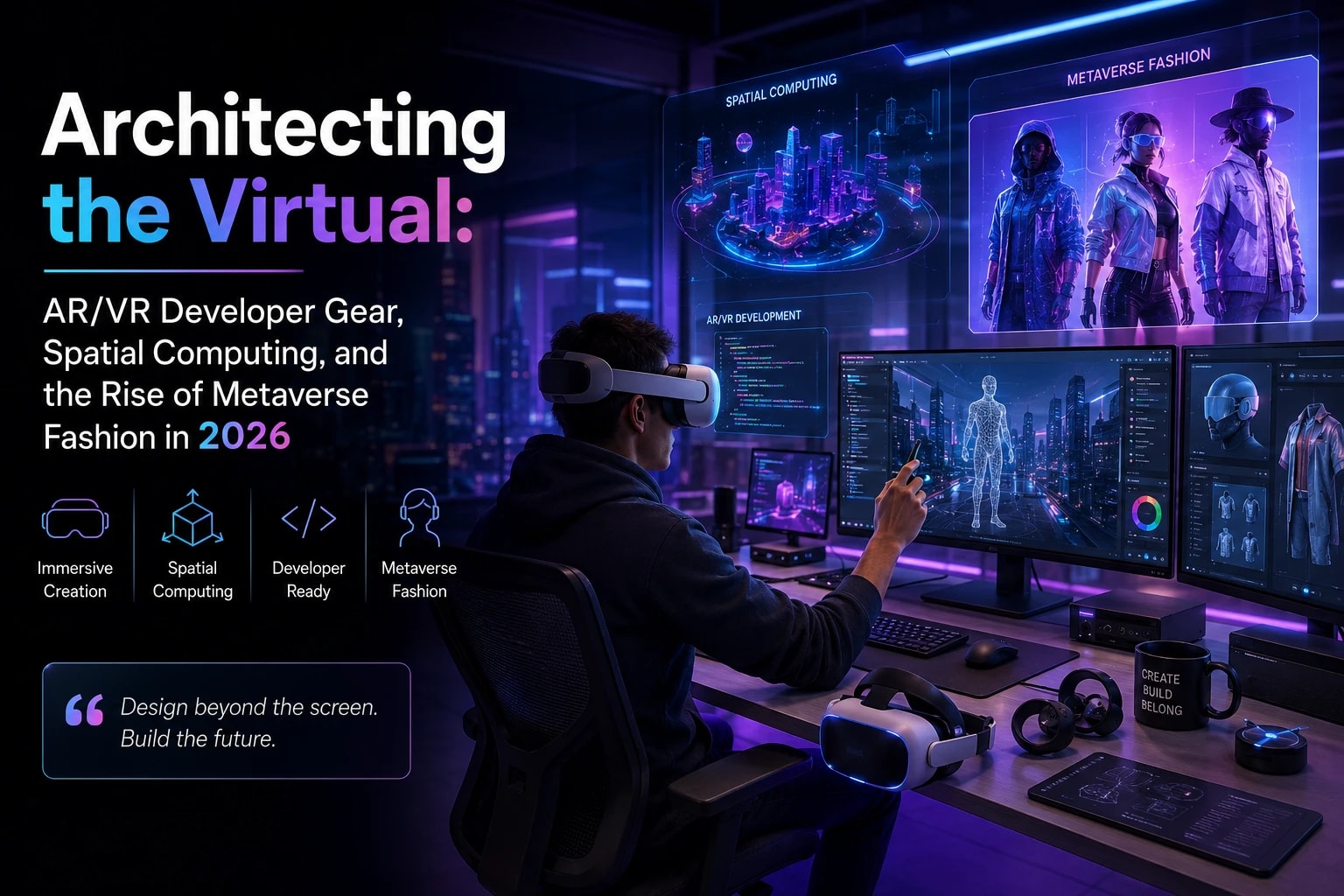
Architecting the Virtual: AR/VR Developer Gear, Spatial Computing, and the Rise of Metaverse Fashion in 2026
The Next Dimension: Why Spatial Computing is the Ultimate E-Commerce Frontier
We have officially moved beyond the flat screen. In 2026, the two-dimensional internet is rapidly being replaced by immersive, three-dimensional digital environments. This massive technological leap is known as Spatial Computing—a realm where the physical and digital worlds seamlessly blend through Augmented Reality (AR), Virtual Reality (VR), and Mixed Reality (MR).
At the forefront of this revolution is a new class of professional: the Spatial Developer. These engineers, 3D artists, and spatial UX designers are the architects building the next generation of the internet. Because their work demands unprecedented processing power and physical endurance, an entire high-end sub-industry has emerged to support them.
Let's explore the booming economics of spatial computing, the specialized hardware required for AR/VR development, and the fascinating emergence of "Phygital" metaverse fashion.
1. The $229 Billion Spatial Era
The economic growth of the spatial computing sector is absolutely staggering. According to 2026 market intelligence reports, the global market size has reached approximately $229.38 billion and is projecting aggressive growth at a CAGR of 21.7%, tracking toward the $1 trillion mark by 2034.
This explosive growth isn't just coming from consumer gaming. It is heavily fueled by enterprise VR solutions transforming how massive conglomerates do business.
| Market Segment | 2026 Growth Dynamics | Primary Target Audience |
| Enterprise Mixed Reality | The fastest-growing B2B segment. Used for remote surgical training, industrial digital twins, and virtual prototyping. | Healthcare, Automotive, and Manufacturing conglomerates. |
| Consumer AR Wearables | The shift from bulky headsets to lightweight, stylish AR smart glasses that tether wirelessly to smartphones. | Tech enthusiasts and early-adopter consumers. |
| Spatial E-Commerce | Brands building virtual stores where customers interact with full 3D product models before buying physical items. | Retail giants and luxury fashion houses. |
2. The Developer's Hardware Ecosystem
To build a flawless mixed reality experience, a developer needs hardware that far exceeds standard enterprise requirements. The spatial computing development rig is a highly specialized, ultra-premium setup.
-
The Tethered 3D Workstation: While the end-user might experience the app on a standalone wireless headset (like the Meta Quest), the developer must compile and render massive 3D assets locally. This requires massive multi-core processors (like AMD Threadrippers) and top-tier discrete GPUs (like the NVIDIA RTX 50-series) to render complex physics, volumetric lighting, and spatial audio in real-time. Selling these $5,000+ pre-configured workstations yields massive Average Order Values (AOV) for B2B e-commerce vendors.
-
Headset Testing Fleets: A spatial developer cannot rely on a single headset. To ensure cross-platform compatibility, a studio must maintain a "fleet" of test devices, including the Apple Vision Pro, the Meta Quest line, and specialized AR glasses like XREAL. Storing, charging, and managing these devices requires specialized desktop docks and UV-sanitization cabinets—a highly lucrative niche for tech accessory brands.
3. Ergonomics in the Z-Axis
Traditional ergonomics focused entirely on the X and Y axes—keeping your wrists flat and your monitor at eye level. Spatial developers, however, work in the Z-axis (depth). They spend hours with heavy headsets strapped to their faces, looking up, down, and walking around their physical space while debugging virtual code.
-
Combating "VR Neck": The primary occupational hazard for a spatial developer is cervical strain. Wearing a 600-gram headset for six hours a day places unnatural torque on the neck muscles. Premium e-commerce brands are now selling custom, aftermarket counter-weights that attach to the back of the headset strap. This pulls the center of gravity back to the middle of the skull, instantly relieving neck tension.
-
Zero-Gravity Seating: Because developers often test "seated VR" experiences, traditional upright chairs are totally inadequate. The elite standard is the "Zero-Gravity" ergonomic chair. It reclines the developer to a 130-degree angle, completely decompressing the spine while they interact with enterprise VR solutions.
4. The Rise of "Phygital" Metaverse Fashion
As we spend more time in spatial environments, our digital representation—our avatar—becomes just as important as our physical appearance. This has birthed Metaverse Fashion, a multi-billion-dollar intersection of high fashion, blockchain technology, and spatial computing.
In 2026, tech-savvy consumers demand "Phygital" garments—items that exist in both realities simultaneously. A consumer purchases a premium, physical tech-wear hoodie with an encrypted NFC chip embedded inside the sleeve. Tapping their smartphone to the chip authenticates the garment via a blockchain ledger (proving it is real) and instantly unlocks the exact same 3D digital hoodie for their avatar in spatial platforms like Decentraland or Horizon Worlds.
The Developer's Aesthetic
The engineers building these worlds have adopted their own fashion subculture, heavily influenced by cyberpunk aesthetics and tactical tech-wear:
-
Sensor-Friendly Fabrics: Developers wear matte, non-reflective black clothing. Highly reflective fabrics or chaotic patterns can easily confuse the infrared tracking cameras on AR/VR headsets, causing "tracking drift" when testing hand gestures.
-
The Haptic Suit Interface: Elite developers are integrating haptic feedback directly into their apparel. Specialized vests and gloves feature micro-actuators that provide physical resistance when the developer "touches" a virtual object, perfectly blurring the line between the physical and the digital.
5. E-Commerce Strategy: Selling the Spatial Future
For digital entrepreneurs, the spatial computing niche is the definition of a high-ticket, high-margin frontier. However, selling to developers who literally build digital realities requires an absolutely flawless e-commerce execution.
-
The Custom Headless Storefront: If you are selling a $2,000 Apple Vision Pro accessory, your website cannot run on a sluggish, templated platform. Building your storefront on a headless architecture (like Next.js) is a non-negotiable requirement. It ensures lightning-fast page loads and allows you to natively embed WebXR components. Instead of a flat 2D image, a developer visiting your site can project a 3D model of your product directly onto their physical desk before clicking the checkout button.
-
B2B Enterprise Outfitting: The true scaling opportunity lies in targeting corporate XR studios. Do not waste your budget on broad consumer ads. Target titles like "Head of XR" or "Lead Spatial Computing Architect" on LinkedIn. Pitch bundled "Developer Survival Kits" that include aftermarket headset comfort mods, UV-C sanitization stations, and anti-fatigue standing mats.
6. Privacy First: The Security Accessory Market
As spatial computing devices actively scan our physical rooms, track our eye movements, and map our hand gestures, data privacy has become the paramount concern for 2026.
E-commerce brands that sell privacy-centric accessories—such as physical privacy covers for headset cameras, or specialized Faraday bags designed to block Wi-Fi signals from transmitting headset tracking data when not in use—are seeing massive sales volumes from security-conscious enterprise buyers.
Ultimately, the developers, designers, and engineers building this 3D internet require gear that is just as advanced as the code they write. For the ambitious e-commerce founder, mastering this $229 billion market means operating at the absolute bleeding edge of technology, fashion, and human-computer interaction.