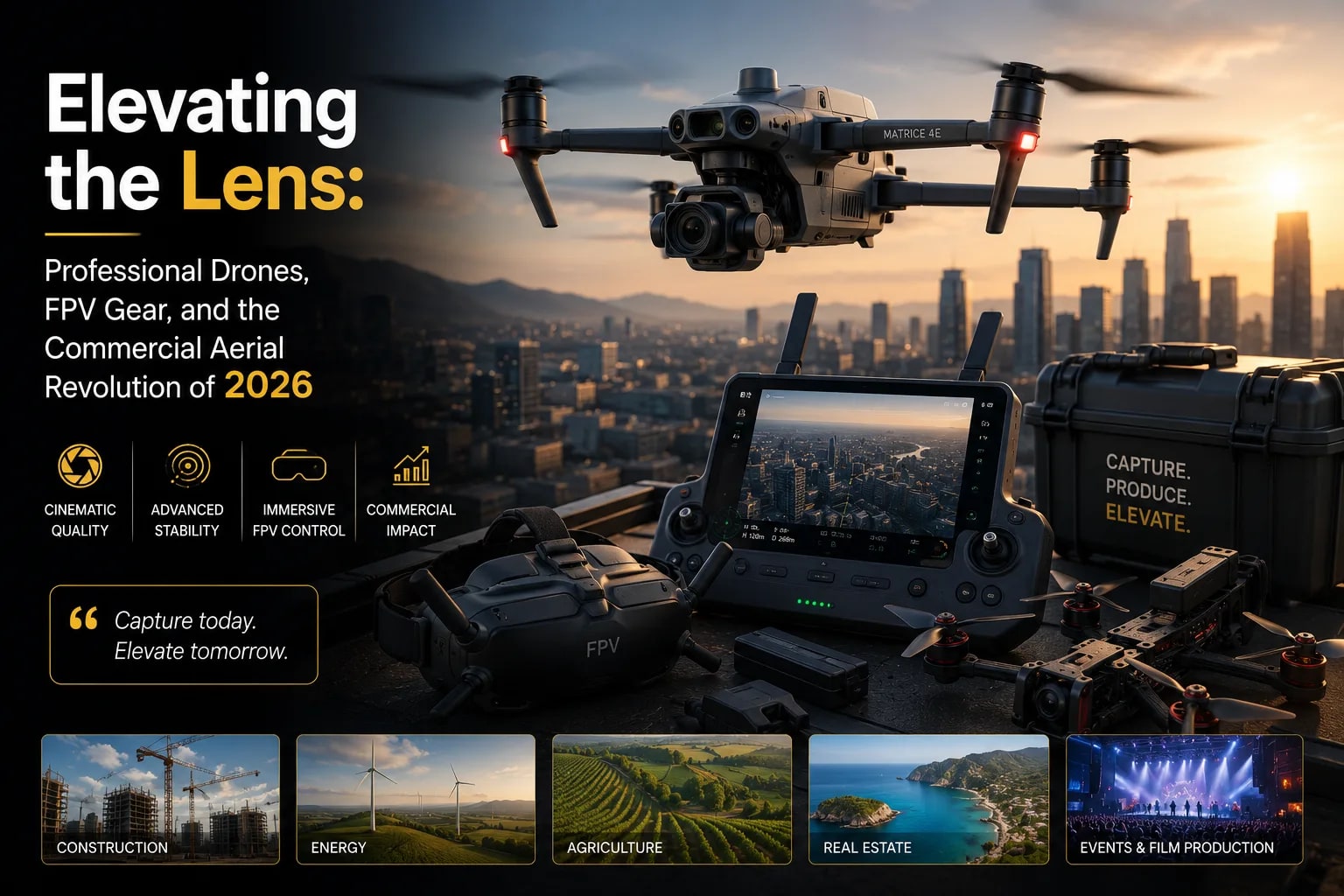
Elevating the Lens: Professional Drones, FPV Gear, and the Commercial Aerial Revolution of 2026
The Sky is Open for Business: How Commercial Drones Are Changing the World
The perspective of the sky is no longer reserved for helicopters and multi-million-dollar film budgets. We have entered an incredible new era of aerial robotics. What began as a consumer hobby has rapidly matured into a sophisticated, highly regulated, and immensely profitable global industry.
Today, enterprise drones and professional cinematography rigs are completely reshaping how we build infrastructure, secure borders, and capture blockbuster action sequences. Let's explore the massive economics of the commercial drone market, the hardware powering aerial cinematography, and how digital entrepreneurs can scale a high-ticket e-commerce brand in this space.
1. A Multi-Billion-Dollar Boom
The commercial drone sector is currently experiencing unprecedented exponential growth. According to 2026 market intelligence, the global drone market is projected to reach $100.74 billion this year, and is expected to expand at a Compound Annual Growth Rate (CAGR) of 9.63% to reach a staggering $210.26 billion by 2034.
This hyper-growth is driven almost entirely by B2B adoption. Corporations are moving away from treating drones as experimental toys and are instead integrating them deeply into their daily workflows to improve operational efficiency and data collection capabilities.
| Market Segment | 2026 Strategic Trend | Primary B2B Audience |
| Industrial Inspection & Mapping | Drones replace human scaffolding workers for dangerous cell tower, powerline, and pipeline inspections. | Construction conglomerates, Energy Grids, and Real Estate Developers. |
| Cinematography & Media | The integration of heavy-lift drones capable of carrying full-sized RED or ARRI cinema cameras. | Hollywood Studios, Advertising Agencies, and Independent Production Houses. |
| Precision Agriculture | Drones utilize multispectral sensors to analyze crop health and automate targeted pesticide spraying. | Large-scale farming operations and AgTech firms. |
2. The Cinematic FPV Revolution
For years, aerial cinematography was defined by slow, majestic, stabilized tracking shots. While beautiful, they lacked visceral energy. This completely changed with the mainstream adoption of Cinematic FPV (First-Person View) drones.
Unlike standard GPS-stabilized drones that hover perfectly in place, FPV drones are fully manual. The pilot wears VR-style goggles that receive a zero-latency video feed directly from the drone’s nose. This allows them to perform aggressive acrobatics, dive down the sides of skyscrapers, and fly through incredibly tight gaps at speeds exceeding 90 MPH.
The "Cine-Lifter" Class: Initially, FPV drones could only carry lightweight action cameras. However, the true disruption in the film industry is the "Cine-Lifter." These are massive, custom-built octocopters designed by elite engineers to carry 5-to-10-pound Hollywood cinema cameras (like the RED Komodo). Directors can now achieve continuous, high-speed tracking shots in a single take, birthing an entirely new visual language in modern filmmaking.
3. UAV Payload Systems: It’s All About the Sensors
In the enterprise sector, the drone itself is merely a delivery vehicle. The true value lies in the advanced sensors and cameras attached to it.
-
LiDAR Surveying Drones: Light Detection and Ranging (LiDAR) sensors send out millions of laser pulses per second to measure exact distances, penetrating through dense forest canopies to map the actual ground below. Civil engineers use this to generate centimeter-accurate 3D maps of entire cities in a matter of hours.
-
Radiometric Thermal Imaging: Drones equipped with advanced thermal sensors are mandatory for industrial maintenance. For example, energy companies use them to fly over massive solar farms. The thermal camera instantly identifies defective cells (hot spots) that the human eye cannot see, saving companies hundreds of thousands of dollars in lost power generation.
4. Drone Fleet Management
As major corporations scale their drone programs, managing the logistics becomes a massive software challenge. You cannot manually pilot 50 drones inspecting a 1,000-mile oil pipeline. This has given rise to a highly lucrative SaaS niche: Commercial Drone Fleet Management.
The future of automated security and inspection relies on "Drone-in-a-Box" (DIAB) systems. A weather-proof box sits permanently on the roof of a corporate campus. On a scheduled interval, the box opens, the drone autonomously launches, flies a pre-programmed security route using AI obstacle avoidance, lands back in the box, and automatically recharges. The massive data captured is then automatically ingested into a cloud platform where AI flags anomalies (like a crack in a concrete bridge).
5. Scaling a High-Ticket Drone Brand
For digital entrepreneurs, the professional drone market offers some of the highest Average Order Values (AOV) in the e-commerce sector. A single enterprise drone can easily retail for $10,000 to $25,000. However, converting B2B clients at this price point requires flawless execution.
-
Headless E-Commerce Architecture: Buyers need to see the exact quality of the camera payloads. Building your storefront on a headless framework (like Next.js) allows you to embed uncompressed 4K aerial footage and interactive 3D models of the drones without slowing down your site. Instantaneous page loads build the immense brand trust required for a $15,000 transaction.
-
Precision B2B Marketing: Consumer advertising tactics do not work here. Rely heavily on high-intent Google Ads targeting terms like "Buy RTK Surveying Drones." Use Meta Ads to re-target procurement managers with case-study videos showing exactly how a specific LiDAR drone saved a construction company $50,000 on a single project. Selling the ROI is how you close high-ticket B2B sales.
6. The Regulatory Horizon
Operating a commercial drone business requires strict adherence to aviation law. The most critical technological shift today is the mandatory enforcement of Remote ID globally.
Remote ID acts as a digital license plate for drones. Every commercial UAV must broadcast its location, altitude, and operator identification in real-time to local aviation authorities. For e-commerce retailers, this means ensuring every piece of hardware sold is fully compliant out-of-the-box. Brands that offer compliance consulting, automated flight-logging software, and commercial aviation insurance alongside their hardware sales are seeing massive increases in B2B client retention.
The narrative surrounding drones has permanently shifted from a recreational novelty to an essential pillar of industrial and creative infrastructure. For the ambitious e-commerce entrepreneur, this commercial drone market is a high-margin frontier waiting to be dominated by brands that understand premium hardware, flawless digital architecture, and data-driven B2B marketing.