The Death of the Bezel: How Ultra-Wide Monitors are Redefining Executive Productivity in 2026
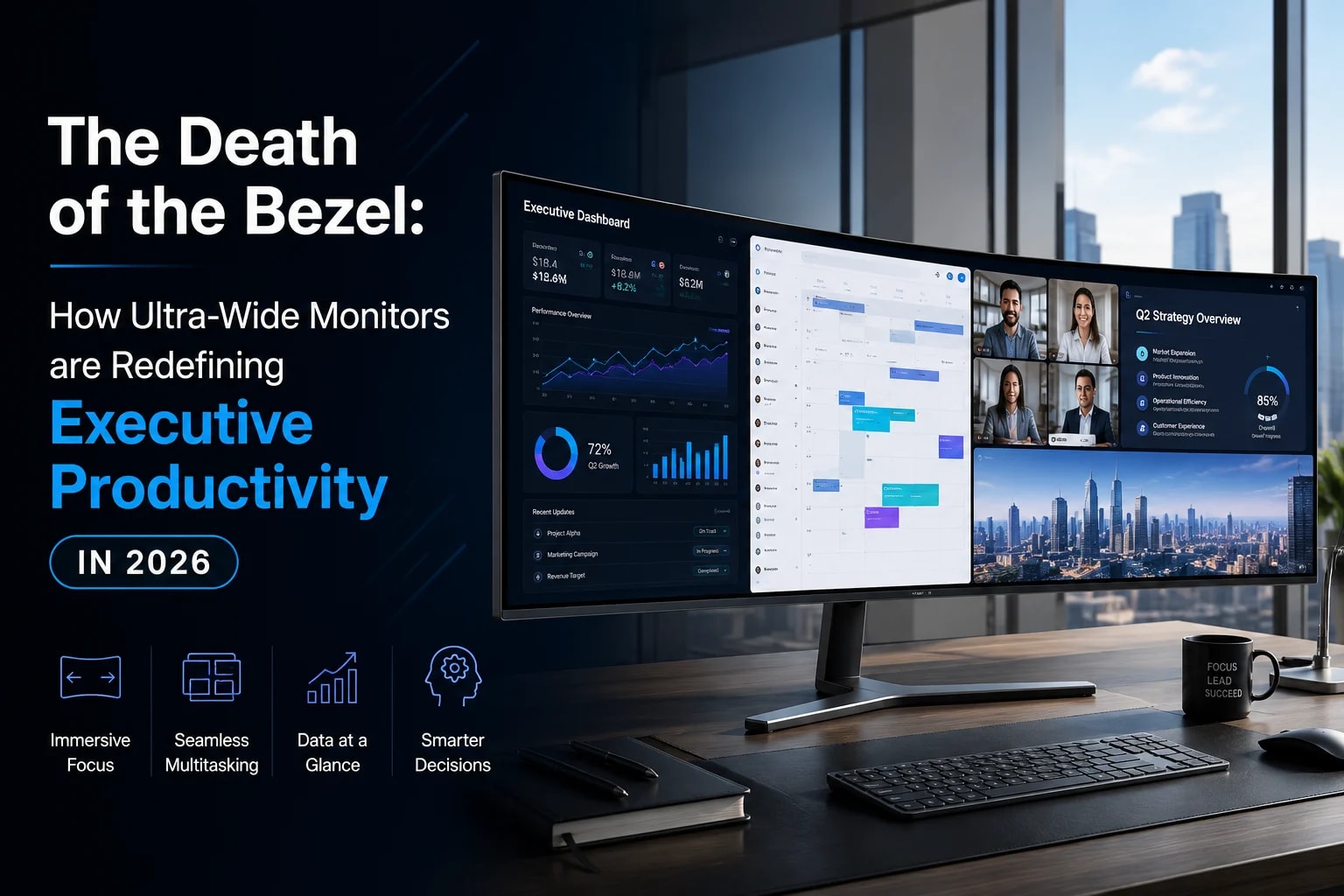
For the past decade, having a dual-monitor setup was the ultimate flex for a "power user." Two 24-inch screens side-by-side meant you were serious about productivity. But that setup always had a massive flaw: the bezel gap. Staring directly into the thick plastic frames dividing your workspace breaks your focus, causes eye fatigue, and fragments your digital workflow.
Fast forward to 2026, and the global workforce has found a much better solution. The Ultra-Wide Curved Monitor has evolved from a niche gaming luxury into an absolute necessity for the modern high-performance workstation.
By offering a massive, uninterrupted digital canvas, these displays are completely changing how financial analysts, software developers, and creatives interact with their data. Let’s explore the economics behind this shift, the proven productivity gains, and how e-commerce brands can dominate this high-ticket space.
1. A $13.5 Billion Market Boom
The economic growth in the ultrawide sector is explosive. In 2026, the global ultrawide curved monitor market reached an estimated $13.54 billion and is expected to expand at a massive 13.76% CAGR, projecting a value of nearly $38 billion by 2035.
This growth isn't just coming from everyday consumers upgrading their home offices. It is heavily fueled by corporate IT departments modernizing their entire workflows.
2. The Mathematics of Productivity
When a company upgrades its trading floor or engineering department to ultrawide monitors, it is not just trying to make the office look cool. It is a highly calculated investment.
-
The Productivity ROI: Studies from enterprise tech giants reveal that when financial traders switch from a fragmented four-monitor setup to dual 34-inch curved ultrawides, they experience a measurable 12% gain in productivity.
-
Time is Money: A 12% gain translates to nearly 100 hours of extra productivity per employee every single year. For a company with 500 engineers, the return on investment (ROI) of buying premium monitors pays for itself in less than one financial quarter.
Without the physical barrier of bezels, the brain enters a state of "Deep Work." Professionals can seamlessly drag complex financial models or multi-pane code editors across a single, vast horizon without mental fragmentation.
3. The Ergonomics: Why the Curve Matters
A massive 49-inch completely flat screen would actually ruin your posture. To see the edges, you would have to constantly lean forward and turn your neck, leading to severe cervical strain. That is exactly why the curvature of the monitor is an engineered necessity.
-
Focal Distance Equalization: Premium ultrawides feature a specific curvature rating (typically between 1000R and 1800R). This curve ensures that the dead-center of the screen and the far edges are at the exact same physical distance from your eyes.
-
Beating Computer Vision Syndrome: Because the focal distance never changes, your ocular muscles do not have to constantly refocus as you scan the screen. This drastically reduces digital eye strain, allowing professionals to work comfortably for 10 to 12 hours a day.
4. The Single-Cable Workspace Dream
One of the most powerful features driving corporate bulk purchases in 2026 is the monitor acting as a centralized docking station.
Modern premium ultrawides feature advanced Thunderbolt 4 or USB-C Hub technology with heavy Power Delivery (up to 100W). An executive can walk into their office, place their laptop on the desk, and plug in exactly one cable. Instantly, the laptop is charging, connected to the massive display, wired directly to Ethernet, and linked to a wireless mouse, mechanical keyboard, and webcam.
For IT managers, this totally eliminates the need to buy separate, expensive docking stations for every desk, making the high upfront cost of an ultrawide highly economically viable.
5. Scaling an E-Commerce Brand in this Niche
For digital entrepreneurs, the ultrawide monitor market is the ultimate high-ticket e-commerce play. With Average Order Values (AOV) frequently exceeding $800 to $1,500, you don't need millions of customers to generate massive revenue.
-
Targeting the Enterprise: Consumer Facebook ads are incredibly inefficient for high-ticket tech. Your strategy must rely on targeted LinkedIn B2B campaigns aimed at "IT Procurement Managers" and "Chief Information Officers," pitching bulk office modernizations.
-
Headless Commerce: If you are selling a $1,500 monitor, your website must feel like a luxury boutique. Utilizing a custom, headless architecture (like Next.js) ensures instantaneous page loads. It allows you to feature buttery-smooth video loops and 3D Augmented Reality (AR) models so buyers can "project" the monitor onto their real-world desk before purchasing.
6. The Multi-Tasking Software Ecosystem
Great hardware is nothing without great software. To maximize these massive displays, professionals rely on advanced window-management tools like Microsoft PowerToys (FancyZones) or Dell Display Manager.
These tools allow users to digitally partition their massive 32:9 screen into custom, unbreakable grids. A trader can lock a live data feed to the left 25%, place their primary execution software in the center 50%, and keep their email docked to the right 25%. It creates a perfectly structured digital dashboard that dual monitors can never replicate.
Ultimately, the transition to a curved ultrawide display is a one-way street. Once a professional experiences the uninterrupted workflow, the ergonomic comfort, and the minimalist aesthetic of a single-cable setup, they will never go back to the bezel.